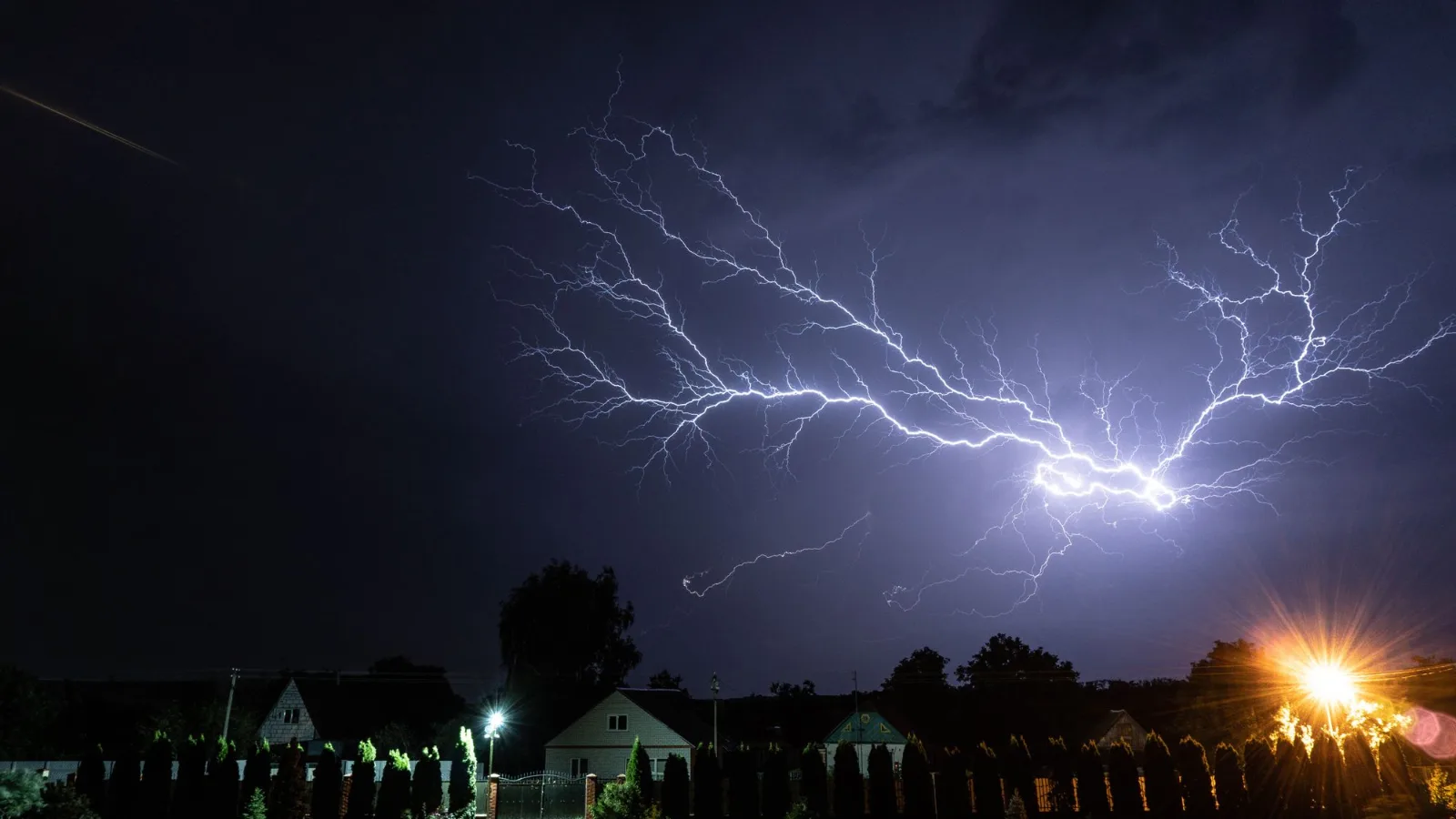
The weather alert buzzes at 6:40 on a Wednesday evening: a line of storms, power likely out by morning. You do not need a plan. You need one small chore. Wheel the power station next to the kitchen outlet, plug it in, and watch the screen climb to 100% while you wash up. Nothing about it feels like preparing for an emergency, and that is the point. At 3 a.m. the lights go out and the fridge does not stop humming. This guide is about choosing the one you plug in on Wednesday.
For most homes, the Jackery Explorer 2000 v2 is the portable power station to buy for home backup. Its 2,042 Wh battery keeps a fridge, Wi-Fi, lights and phones going about 18 hours by our math, it is the lightest 2 kWh unit here at about 39.5 lb, and it refills from a wall outlet in about 1.75 hours.
- Run more at once: DJI Power 2000 (3,000W output, same 2 kWh)
- Longest battery life: BLUETTI Elite 200 V2 (6,000+ cycles to 80%, maker)
- Start small, grow later: EcoFlow DELTA 3 Plus (1 kWh, expands to 5 kWh)
- Apartment or condo: Anker SOLIX C1000 Gen 2 (24.9 lb, full in 49 minutes)
The five power stations at a glance
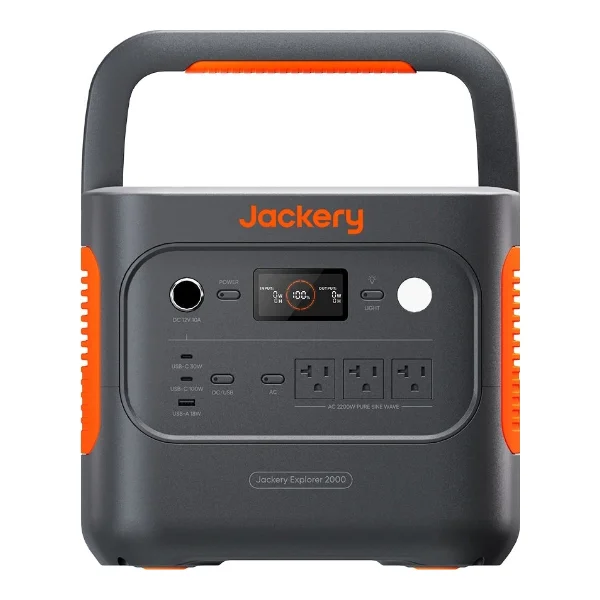 Best for most homesJackery Explorer 2000 v22,042 Wh, 2,200W. Lightest 2 kWh unit here at 39.5 lb.Check price on Amazon
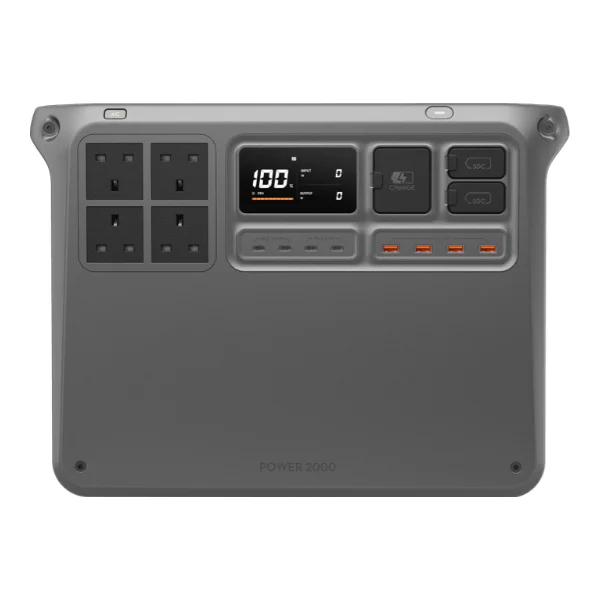 Best for running more at onceDJI Power 20002,048 Wh, 3,000W. Two 140W USB-C ports and a 45 minute 0 to 80% recharge.Check price on Amazon
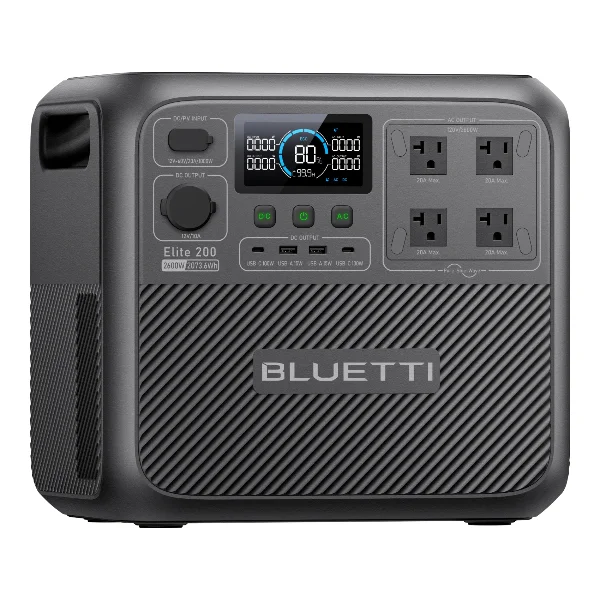 Best for long battery lifeBLUETTI Elite 200 V22,073.6 Wh, 2,600W. 6,000+ cycles to 80% (maker).Check price on Amazon
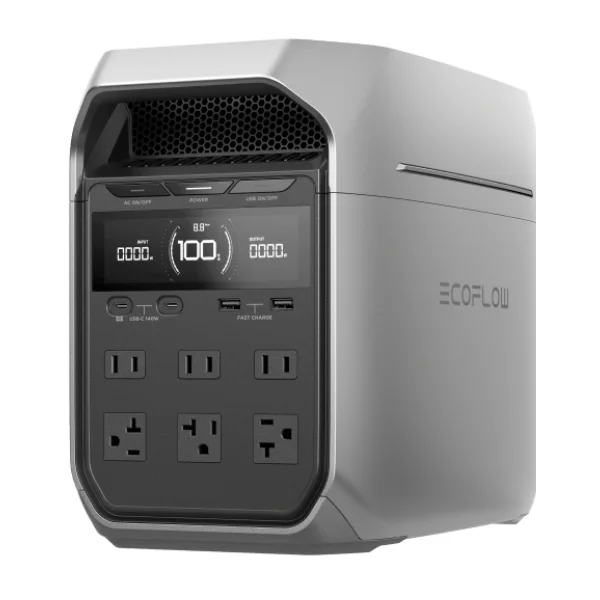 Best to start small and growEcoFlow DELTA 3 Plus1,024 Wh, 1,800W. Expands from 1 kWh to 5 kWh.Check price on Amazon
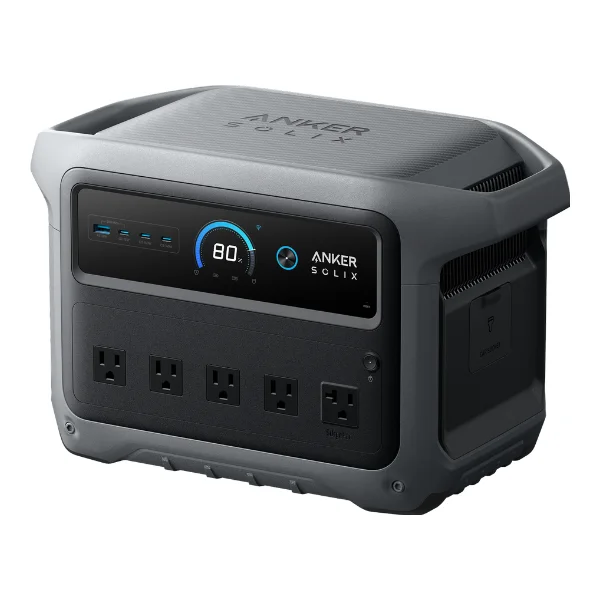 Best for apartments and fast top-upsAnker SOLIX C1000 Gen 21,024 Wh, 2,000W. 24.9 lb and a 49 minute recharge.Check price on Amazon
Size it to your fridge, not your house
A portable power station is not a whole-house system. It is the right size when it carries the few things that cannot wait: the fridge and freezer, the router, a few lights, phone and laptop chargers, and for many homes the furnace fan. Together those use far less than you would guess.
Three loads cover most plans. We use the same averages across OutagePicks: a refrigerator at 60 W, Wi-Fi at 20 W, four LED bulbs at 40 W for six hours, and phones and a laptop at 30 W for six hours. A gas furnace blower adds 382 W while it runs, from a U.S. Department of Energy example. Swap in your own watts, or let our outage planner do it.
Runtime ≈ battery Wh × 0.85 ÷ load W. The 0.85 covers inverter losses.
Jackery Explorer 2000 v2 on fridge and basics: 2,042 × 0.85 ÷ 98 ≈ 17.7 hours.
A closed fridge keeps food safe for about 4 hours without power, and a full freezer for about 48 hours (FoodSafety.gov). The battery is what turns that 4-hour clock into a non-event.
| Your plan | Average draw | Energy per day |
|---|---|---|
| Fridge only | 60 W | 1,440 Wh |
| Fridge, Wi-Fi, lights and phones | 98 W | 2,340 Wh |
| Same, plus a gas furnace fan for 8 hours | 225 W | 5,396 Wh |
Furnace blower draw is a DOE analysis example for an older PSC motor; newer variable-speed blowers draw less. Fridge: 60 W covers most full-size models; an ENERGY STAR 18 cu ft model averages closer to 41 W (DOE).
For scale, the average U.S. customer lost power for about 11 hours in 2024 and about 4.5 hours in 2025 (EIA). A unit that carries fridge and basics for 18 hours covers the typical outage. The long ones, a multi-day ice storm or a hurricane, are where you plan to recharge or step up to a bigger system.
The five power stations, up close
Each unit gets the same treatment: what it does well, the catch, what it will not run, and specs straight from the maker. Runtimes use the three loads from the section above, so you can compare units one to one.
Jackery Explorer 2000 v2
Power station only; panels sold separately
This is the one we would hand a neighbor who says “I just want the fridge, the router and the phones to make it through the night.” Its 2,042 Wh battery carries fridge and basics about 18 hours and a bare fridge about 29 hours before anything is plugged back in.
At about 39.5 lb it is the lightest 2 kWh unit in this guide, 14 lb lighter than the BLUETTI and 9 lb lighter than the DJI. It is also quiet, 30 dB in Quiet Mode and 45 dB at full load measured at 1 m, with under 20 ms switchover, so the router does not blink when the grid drops. Jackery says it holds about 95% of its charge after 12 months in storage, which suits a unit that sits in a closet until a storm.
- Battery
- 2,042 Wh LiFePO4
- Output
- 2,200W (4,400W surge)
- Voltage
- 120V only
- Expansion
- None
- Solar input
- 400W max
- Weight
- About 39.5 lb
- Cycle life
- 4,000 to 70% (maker)
- Warranty
- 3+2 years (maker)
- Lightest 2 kWh unit here, about 39.5 lb
- Full wall recharge in about 1.75 hours
- Quiet: 30 dB in Quiet Mode, 45 dB at full load
- Under 20 ms UPS switchover for routers and computers
- 120V only, and you cannot add batteries later
- A 1,500W space heater empties it in about an hour
- Solar input is capped at 400W, so panels refill it slowly in winter
- The 5-year warranty is advertised only for purchases at jackery.com
Best for: A house or townhouse where fridge, router, lights and phones must last 12 to 24 hours, with room to store a 40 lb box.
What it won’t run: A 240V well pump, central AC, an electric range or dryer, or a 1,500W space heater for more than about an hour.
Skip it if: you want to add batteries later; the EcoFlow DELTA 3 Plus is built for that.
Specs: Jackery Explorer 2000 v2 product page and tech specs (2,042 Wh, 2,200W rated, 4,400W surge, 400W solar input, 4,000 cycles to 70%, 1.75 h AC charge, 39.5 lb), checked Nov. 2, 2026.
DJI Power 2000
Power station only; panels sold separately
If your list is long, the DJI is the one to look at. Its AC output is rated at 120V and 25 A, which is 3,000W, 800W more than the Jackery from a battery of the same size. That headroom lets a fridge start up while a kettle or a coffee maker is already running, without tripping.
It also has four USB-C ports, two of them at 140W, so a work-from-home laptop and a phone charge at full speed without an adapter brick. DJI quotes a 0 to 80% recharge in 45 minutes. Headroom is not hours, though: it holds the same 2 kWh, so the runtimes match the Jackery and BLUETTI.
- Battery
- 2,048 Wh LFP
- Output
- 3,000W (120V, 25 A)
- Voltage
- 120V only
- Ports
- 4 AC, 4 USB-C, 4 USB-A
- Wall recharge
- 0 to 80% in 45 min (maker)
- Weight
- About 48.5 lb
- Cycle life
- 4,000 to 80% (maker)
- Warranty
- 5 years (maker default)
- 3,000W output, the most in this guide
- Two 140W USB-C ports for laptops
- Fast 0 to 80% recharge in 45 minutes (maker)
- 5-year default warranty (maker)
- At about 48.5 lb it is 9 lb heavier than the Jackery with the same battery
- The spec page does not publish a UPS switchover time
- More power at once does not mean more hours
- Solar input goes through DJI’s SDC ports, so check a panel is compatible before you buy one
Best for: Households that run a coffee maker, kettle or small heater beside the fridge, and people working from a laptop during an outage.
What it won’t run: A 240V well pump, central AC or an electric range, and a 1,500W heater for more than about an hour.
Skip it if: weight or stairs matter most; the 39.5 lb Jackery carries the same 2 kWh.
Specs: DJI Power 2000 specs page and DJI Store page (2,048 Wh LFP, 120V 25 A AC output, 4,000 cycles to 80%, 22 kg, 5-year default warranty), checked Nov. 2, 2026.
BLUETTI Elite 200 V2
Power station only; panels sold separately
BLUETTI’s pitch is longevity. It publishes 6,000+ cycles to 80% capacity, 50% more than the 4,000 cycles to 80% that Anker, DJI and EcoFlow publish. For a once-a-year storm that hardly matters. If the unit will also be your daily laptop and router UPS, or you want it to last a decade or more, it does.
It charges from the wall at 1,800W, full in about 1.4 hours, and accepts up to 1,000W of solar if you add panels later, two and a half times the Jackery’s 400W. The price of all that is weight: at 53.4 lb it is the heaviest unit here.
- Battery
- 2,073.6 Wh LiFePO4
- Output
- 2,600W (3,900W Power Lifting)
- Wall recharge
- 1,800W, about 1.4 h
- Solar input
- 1,000W max
- Weight
- 53.4 lb
- Noise
- As low as 16 dB (light load)
- Cycle life
- 6,000+ to 80% (maker)
- Warranty
- 5 years (maker)
- 6,000+ cycles to 80% (maker), the longest life in this guide
- Full wall recharge in about 1.4 hours at 1,800W
- Accepts up to 1,000W of solar if you add panels later
- Runs as quiet as 16 dB at light loads (maker)
- At 53.4 lb it is the heaviest 2 kWh unit here
- BLUETTI asks you to top it up to 40 to 60% every 3 to 6 months in storage
- Power Lifting mode (3,900W) is for simple resistive loads such as heaters, not motors
- The spec table we read does not list a UPS switchover time
Best for: People who will use the unit often, or want the longest-lived battery, and have a spot for a 53 lb box.
What it won’t run: A 240V well pump, central AC or an electric dryer, and heaters for more than about an hour.
Skip it if: you need to move it up stairs often; the 39.5 lb Jackery or the 27.6 lb EcoFlow is easier.
Specs: BLUETTI Elite 200 V2 product page (2,073.6 Wh LiFePO4, 2,600W, 3,900W Power Lifting, 1,800W AC input, 1.4 h charge, 1,000W solar, 6,000+ cycles to 80%, 53.4 lb, 5-year warranty), checked Nov. 2, 2026.
EcoFlow DELTA 3 Plus
Power station only; extra batteries and panels sold separately
If you are not sure how big your outages get, start here. The DELTA 3 Plus is a 27.6 lb, 1,024 Wh unit that carries fridge and basics about 9 hours on its own, and EcoFlow says it expands from 1 to 5 kWh with compatible extra batteries. You buy a first unit now and add capacity once you know what an outage actually costs you.
It recharges fully in 56 minutes from a wall outlet at 1,500W, and its app lists a Storm Warning Alert, aimed at the charge-before-the-storm habit this guide recommends. Switchover is under 10 ms for a router or desktop.
- Battery
- 1,024 Wh LFP
- Output
- 1,800W (3,600W surge)
- Expansion
- 1 to 5 kWh (maker)
- Wall recharge
- 1,500W, full in 56 min
- Solar input
- 2 × 500W
- Weight
- About 27.6 lb
- Cycle life
- 4,000 to 80% (maker)
- Warranty
- 5 years (maker)
- Starts at 27.6 lb and grows from 1 to 5 kWh
- Under 10 ms UPS switchover
- Full wall recharge in 56 minutes
- Two 500W solar inputs for panels later
- On its own, 1 kWh carries fridge and basics about 9 hours, or about 4 with the furnace fan added
- Extra batteries cost more and reaching 5 kWh takes several
- EcoFlow’s own store listed the base model as shipping in late November on Nov. 2, so check the delivery date at checkout
- 120V only
Best for: People who want a first power station now and a bigger system later.
What it won’t run: A 240V well pump or central AC, or a space heater for more than about half an hour.
Skip it if: you already know you need 2 kWh or more on day one; buy a 2 kWh unit instead of stacking batteries.
Specs: EcoFlow DELTA 3 Plus product page and spec table (1,024 Wh LFP, 1,800W, 3,600W surge, 1,500W AC input, 2 × 500W solar, 4,000 cycles to 80%, 27.6 lb, 5-year warranty), checked Nov. 2, 2026.
Anker SOLIX C1000 Gen 2
Power station with car charging cable; panels sold separately
For an apartment or condo, small and fast wins. At 24.9 lb and 15.1 × 8.2 × 9.6 in it is the lightest and most compact unit here, it makes no exhaust, and it fits in a closet. It puts out 2,000W with a 3,000W peak, more than the EcoFlow from the same 1 kWh battery.
Anker rates it for a full recharge in 49 minutes at 1,600W, so even a short warning, or a power flicker between rolling outages, is enough to fill it. The catch is size: 1 kWh carries fridge and basics about 9 hours, and the C1000 Gen 2 does not take extra batteries.
- Battery
- 1,024 Wh
- Output
- 2,000W (3,000W peak)
- Expansion
- None
- Wall recharge
- 1,600W, full in 49 min
- Solar input
- 600W max
- UPS
- 10 ms
- Weight
- 24.9 lb
- Cycle life
- 4,000 to 80% (maker)
- Lightest and most compact unit here at 24.9 lb
- Full wall recharge in 49 minutes at 1,600W
- 2,000W output with 3,000W peak across 10 ports
- 10 ms UPS switchover
- 1 kWh carries fridge and basics about 9 hours, or about 4 with the furnace fan added
- No expansion batteries
- The spec page we read does not state the warranty term, so confirm it on the listing
- Solar input tops out at 600W
Best for: An apartment, condo or townhouse where the plan is fridge, router and phones for a night and the unit has to live in a closet.
What it won’t run: A 240V well pump, central AC or any space heater for more than about half an hour.
Skip it if: your outages run past a day and you cannot add panels; step up to a 2 kWh unit.
Specs: Anker SOLIX C1000 Gen 2 product page and comparison table (1,024 Wh, 2,000W, 3,000W peak, 1,600W AC input, 49 min full recharge, 600W solar, 10 ms UPS, 24.9 lb, 4,000 cycles to 80%), checked Nov. 2, 2026.
Hours of power, side by side
How long each unit carries the three loads from a full battery, with no solar. Hours are our math from each maker’s published capacity.
| Unit | Battery | Fridge only | Fridge and basics | Plus furnace fan | Weight |
|---|---|---|---|---|---|
| Jackery Explorer 2000 v2 | 2,042 Wh | 28.9 h | 17.7 h | 7.7 h | 39.5 lb |
| DJI Power 2000 | 2,048 Wh | 29.0 h | 17.8 h | 7.7 h | 48.5 lb |
| BLUETTI Elite 200 V2 | 2,073.6 Wh | 29.4 h | 18.0 h | 7.8 h | 53.4 lb |
| EcoFlow DELTA 3 Plus | 1,024 Wh | 14.5 h | 8.9 h | 3.9 h | 27.6 lb |
| Anker SOLIX C1000 Gen 2 | 1,024 Wh | 14.5 h | 8.9 h | 3.9 h | 24.9 lb |
Runtime = battery Wh × 0.85 ÷ average load (60 W, 98 W, 225 W). Capacities and weights from maker spec pages. Estimates by our math, not measurements.
Charge it before the storm: wall recharge and cold limits
Home backup with a power station is a habit more than a purchase. When a storm is forecast, charge it to 100% and leave it plugged in, so it is full when the lights go. Recharge speed matters in two cases: a short warning, and rolling outages where power returns for an hour or two.
| Unit | Wall input | Recharge from a wall outlet (maker) |
|---|---|---|
| Anker SOLIX C1000 Gen 2 | 1,600W | 0 to 100% in 49 min |
| EcoFlow DELTA 3 Plus | 1,500W | 0 to 100% in 56 min |
| BLUETTI Elite 200 V2 | 1,800W | 0 to 100% in 1.4 h |
| Jackery Explorer 2000 v2 | Up to 15 A (about 1,800W) | 0 to 100% in about 1.75 h |
| DJI Power 2000 | Up to 15 A (about 1,800W) | 0 to 80% in 45 min |
Maker figures at a wall outlet. 15 A × 120 V is about 1,800W, our math. Real times depend on your circuit.
Two limits catch people out. The first is cold. Jackery and DJI both publish 32°F (0°C) as the lowest temperature at which the unit will charge, while discharging is allowed down to 14°F (-10°C). A unit left in an unheated garage during an ice storm can run but will not recharge. Keep it indoors. We did not find the same limits on the EcoFlow, Anker or BLUETTI pages we read, so check the manual for yours.
The second is running while plugged in. Pass-through mode lets a unit power your devices while it charges from the wall. Jackery lists its bypass at up to 12 A, about 1,440W by our math, so a heavier load drains the battery even while it is plugged in.
The 1,500W trap: what 2 kWh will not do
Watts decide whether a unit can start a device. Watt-hours decide how long it keeps going. A power station that can run a 1,500W space heater will empty itself in about an hour doing it.
| Device on the battery | Typical draw | 2 kWh unit | 1 kWh unit |
|---|---|---|---|
| CPAP machine | 40 W | about 43 h | about 22 h |
| Window air conditioner | 500 W | about 3.5 h | about 1.7 h |
| Microwave | 1,100 W | about 1.6 h | about 0.8 h |
| Space heater | 1,500 W | about 1.2 h | about 0.6 h |
Typical label values; check yours. Hours use about 1,736 Wh usable from a 2,042 Wh unit and 870 Wh from a 1,024 Wh unit (Wh × 0.85). If you rely on a CPAP or other medical device, ask your equipment supplier and your utility about backup and its medical priority program. Nothing here is medical advice.
If heat is the worry, dress the room, close the door, and spend the battery on the furnace fan instead.
If you add panels later
None of these units ships with panels, and a one-day outage does not need them. If you expect longer ones, panels turn a battery into a system. Rated panel watts × 0.75 × December peak sun hours (NREL PVWatts) estimates what a panel puts back on a clear day. A 400W panel returns about 1,640 Wh in Phoenix (5.45 sun hours), about 1,140 Wh in Raleigh (3.81) and about 480 Wh in Seattle (1.59).
Solar input limits differ. The Jackery takes up to 400W, the Anker 600W, and the EcoFlow and BLUETTI up to 1,000W each. A bigger limit does not help if you have no room for the panels, but it lets one clear day refill the battery faster.
Pick by your situation
| If your home… | Buy | Why |
|---|---|---|
| Needs fridge, router, lights and phones through a day, and you want it easy to move | Jackery Explorer 2000 v2 | About 18 hours of fridge and basics at 39.5 lb |
| Runs a coffee maker, kettle or laptop workstation next to the fridge | DJI Power 2000 | 3,000W output and two 140W USB-C ports |
| Will be used often, or kept for many years | BLUETTI Elite 200 V2 | 6,000+ cycles to 80% and a 1.4 hour recharge |
| Wants to start small and may grow | EcoFlow DELTA 3 Plus | 1 kWh now, up to 5 kWh with extra batteries |
| Is an apartment or condo where it lives in a closet | Anker SOLIX C1000 Gen 2 | 24.9 lb and a 49 minute recharge |
If you need to run a 240V well pump or central AC, or you want panels in the box and several days of power, you are shopping for a bigger system. Our solar generator guides cover those. This list is the plug-in-the-wall class, 1 to 2 kWh.
Who should skip a power station
A power station is the right tool for a lot of outages and the wrong one for some. Here is how to tell, and what fits better.
| If this is you | Why a power station falls short | Look at this instead |
|---|---|---|
| You want central AC, electric heat or a 240V well pump running | These units are 120V and top out at 3,000W. Heating and cooling loads empty 2 kWh in an hour or two. | A transfer-switch system or standby generator installed by an electrician, or a larger 120/240V battery kit |
| Your winter outages last three days or more | There are no panels in the box, and 2 kWh covers about 18 hours of basics. A 400W panel returns only about 480 Wh in a Seattle December. | A dual fuel generator outdoors as a backstop, or a bigger battery with panels |
| You only need phones and a router tonight | Wi-Fi for 11 hours (220 Wh) plus phones (180 Wh) is about 400 Wh. A 1 to 2 kWh unit is more than you need. | A small power station around 300 to 500 Wh, or a power bank |
| You rely on powered medical equipment and cannot have a gap | One unit is a single point of failure, and a long outage may outlast its battery. | Your utility’s medical priority program, your equipment supplier’s backup advice, and a second power source |
| You can only store it in an unheated garage | Charging stops below 32°F on the units that publish a limit. | A closet or kitchen corner indoors, then any unit on this list |
Runtime math: usable Wh = rated Wh × 0.85. Winter refill: rated panel watts × 0.75 × December peak sun hours (NREL PVWatts).
What to look for, in order of importance
1. Battery capacity (Wh) for your plan. Take your daily Wh from the table above and divide by 0.85. That is the smallest battery that carries it.
2. Continuous output and surge (W). Add the running watts of what might be on together. A fridge compressor can pull about 1,200W for a second when it starts, so size the surge rating above your biggest motor, not only the running load.
3. Cycle life, compared at the same end point. Makers publish cycles to a capacity: BLUETTI 6,000 to 80%; Anker, DJI and EcoFlow 4,000 to 80%; Jackery 4,000 to 70%. A 70% end point is a looser test than 80%, so the numbers are not like for like.
4. Wall recharge time. Under an hour or two means a short storm warning is enough to fill it.
5. Weight and where it lives. The five units here run from 24.9 lb to 53.4 lb. A unit you can carry to the kitchen is a unit you actually charge.
6. Warranty fine print. Jackery advertises 5 years only for purchases at jackery.com, and lists 3+2 years on its spec table. Read the terms for the listing you buy from.
Safety: indoors, outdoors and what not to plug into the wall
A battery unit makes no exhaust, so you can run it indoors, which is its biggest safety advantage over a gas generator. If you also own a gas or dual-fuel generator, the U.S. Consumer Product Safety Commission is clear: never run it inside a home, garage, basement or shed, keep it at least 20 feet from the house with the exhaust pointed away, and install battery-backed CO alarms on every level. Nearly 100 people die each year in the U.S. from portable generator carbon monoxide.
Plug devices into the unit, not the unit into a wall outlet to power the house. OSHA warns that connecting a generator straight into a building’s wiring can energize utility lines and endanger line workers. Feeding hardwired circuits takes a transfer switch installed by a qualified electrician.
Ask about safety listings. UL 2743 is the standard for portable power packs and UL 9540 for installed energy storage systems. We did not find a UL listing on the maker pages we read for these five, so look for a listing mark on the unit or its box, or ask the maker, if your insurer or landlord requires one.
How we chose these five
We did not test these units ourselves. We compared maker spec pages for capacity, output, recharge, solar input, cycle life, weight and warranty, checked that each was in stock on Amazon for delivery to a U.S. ZIP code (10001) on November 2, 2026, and searched the CPSC recall database: none of these five has been recalled. (EcoFlow recalled an older model, the DELTA Max 2000, in October 2025.) Then we ran every runtime in this guide with the same formulas and public data from NREL, EIA, DOE and CPSC, so you can check our math.
We left out units that were not yet buyable (BLUETTI’s AC180 and Elite 100 V2 list release dates of November 18 and 12, 2026), one whose Amazon listing and maker page disagreed on capacity (the Jackery Explorer 1000 v2), and larger 3 kWh units that belong with the bigger systems. Our How We Review page explains the method in full.
Back to Wednesday evening. With the Jackery Explorer 2000 v2, or whichever unit matches your numbers above, the chore takes a minute. The storm comes through around 3 a.m., the kitchen stays dark and warm with the soft hum of a fridge still running, and the only thing left to decide is whether to go back to sleep.
Questions people ask before buying
Which power station is best for home use?
For most homes, a 2 kWh unit. It carries a fridge, router, lights and phones for about 18 hours and weighs 40 to 55 lb. Our pick is the Jackery Explorer 2000 v2. Choose the DJI Power 2000 if you want more output, the BLUETTI Elite 200 V2 for battery life, and a 1 kWh unit only for short outages.
What is the best power backup for a home?
It depends on what you must keep on. A power station covers fridge, router and phones. A transfer-switch generator or home battery installed by an electrician covers hardwired circuits such as a well pump or furnace. A small UPS keeps a router or computer alive for minutes.
Which is better, BLUETTI or EcoFlow?
Neither wins on every point. Here, BLUETTI’s Elite 200 V2 publishes 6,000+ cycles to 80% and holds 2 kWh, while EcoFlow’s DELTA 3 Plus is lighter at 27.6 lb and expands from 1 to 5 kWh. Pick by battery size, weight and whether you want to add capacity later.
What is the best brand of portable power stations?
Jackery, EcoFlow, Anker SOLIX, BLUETTI and DJI are the established names for home backup, and all five publish full spec pages and 4,000 or more cycles. The best brand for you is the one whose unit matches your Wh, watts and weight limit, so compare numbers rather than logos.
Do portable chargers work during a power outage?
Yes, for phones. A 20,000 mAh power bank holds about 74 Wh, roughly four or five phone charges, and it cannot run a fridge. A power station holds 14 to 28 times more energy and has AC outlets, which is why it is the tool for home backup.
How long will a power station run a refrigerator?
A 2,042 Wh unit runs a fridge that averages 60 W for about 29 hours (2,042 × 0.85 ÷ 60), and a 1,024 Wh unit for about 14.5 hours, before any solar. Add the router, lights and phone chargers and the 2 kWh unit falls to about 18 hours.
Related guides
- Solar Generators for Home Backup, Sized to What You Need to Keep On: six setups with panels, for 240V loads, multi-day outages and how a winter sun changes the refill math
Sources and Further Reading
- U.S. Energy Information Administration: Today in Energy, 2024 outage duration Average U.S. customer outage time, 2024.
- EIA Electric Power Annual, Table 11.1: Reliability Outage duration by year, 2025 included.
- NREL PVWatts calculator December peak sun hours by city.
- FoodSafety.gov: Food Safety During a Power Outage How long fridge and freezer food stays safe.
- U.S. Consumer Product Safety Commission: carbon monoxide risks during power outages Generator safety.
- OSHA: Using Portable Generators Safely Why not to connect a generator to house wiring.
- UL: Q&A on portable power packs UL 2743 and UL 9540.