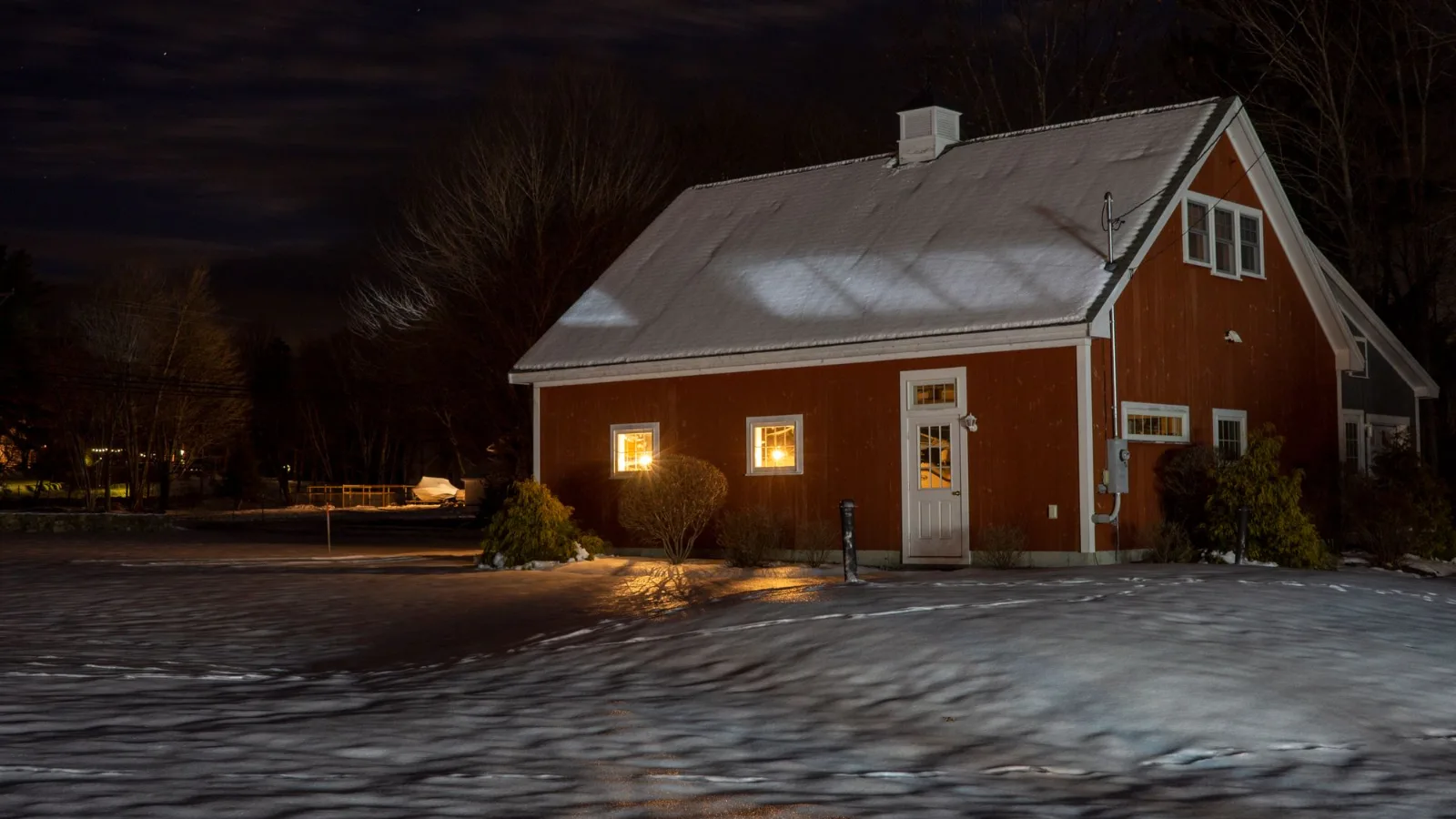
The ice storm takes the power out a little after dinner. By 10 p.m. the house has gone quiet in a way you notice: no fridge hum, no furnace fan, no router light. You are not worried about the TV. You are doing math in your head about the milk, the medicine in the door shelf, and how cold the bedrooms will get by morning. That is the math this guide does for you, with real numbers, before you spend a couple thousand dollars.
For most homes, the Jackery HomePower 3600 Plus with two 200W panels is the setup to buy. Its 3,584 Wh battery keeps a fridge, Wi-Fi, lights and phones going for about 31 hours by our math, it grows to about 21.5 kWh with add-on batteries, and it rolls like a suitcase.
- Well pump, central AC or other 240V loads: EcoFlow DELTA Pro 3 (4,096 Wh, 120/240V from one unit)
- Most power at once, wired to your panel: Anker SOLIX F3800 Plus (6,000W, 120/240V)
- Big battery, smaller budget: Jackery HomePower 3000 kit (3,072 Wh)
- Townhouse, condo or a smaller plan: Anker SOLIX C2000 Gen 2 with PS400 panel, or EcoFlow DELTA 3 Max Plus if you want to add batteries later
The six setups at a glance
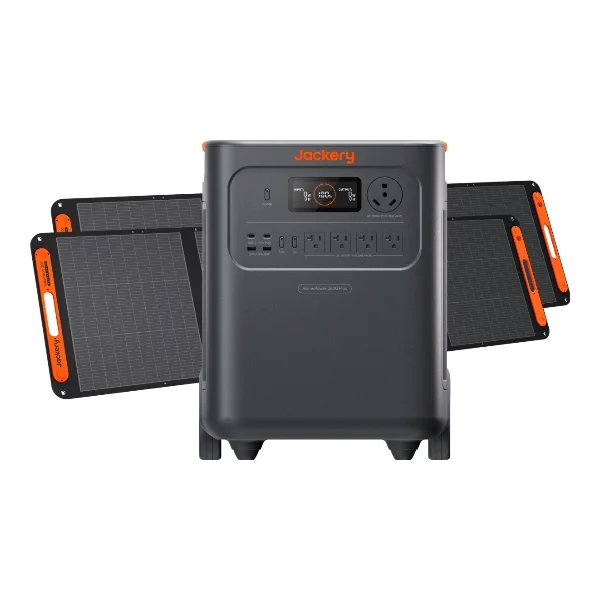 Best for most homesJackery HomePower 3600 Plus kit3,584 Wh, 3,600W. About 31 hours of fridge and basics by our math; grows to about 21.5 kWh.Check price on Amazon
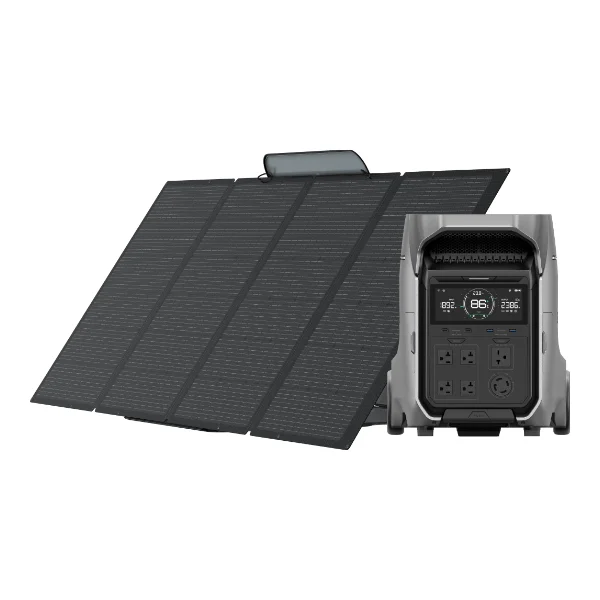 Best for well pumps and 240VEcoFlow DELTA Pro 3 kit4,096 Wh, 4,000W, 120/240V from one unit. Biggest panel set here.Check price on Amazon
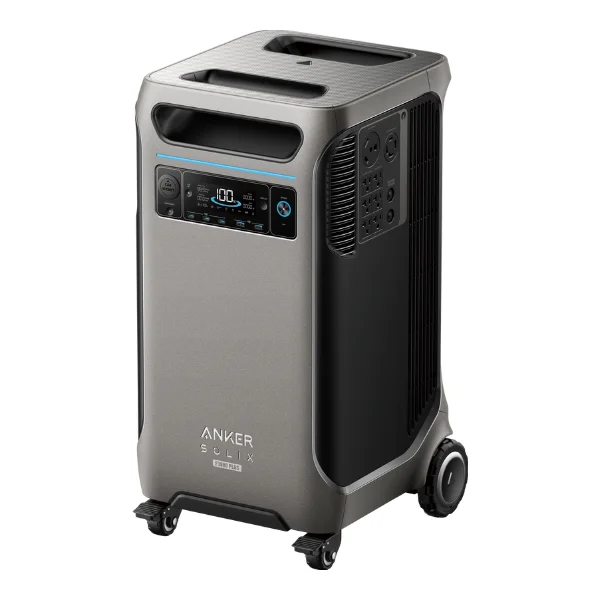 Best for running the most at onceAnker SOLIX F3800 Plus3,840 Wh, 6,000W, 120/240V. Takes up to 3,200W of solar.Check price on Amazon
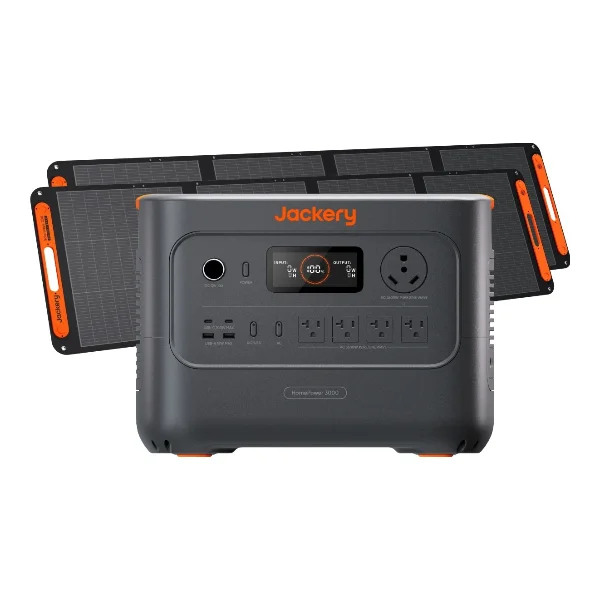 Best value for a big batteryJackery HomePower 3000 kit3,072 Wh in a 59.5 lb box. About 27 hours of fridge and basics.Check price on Amazon
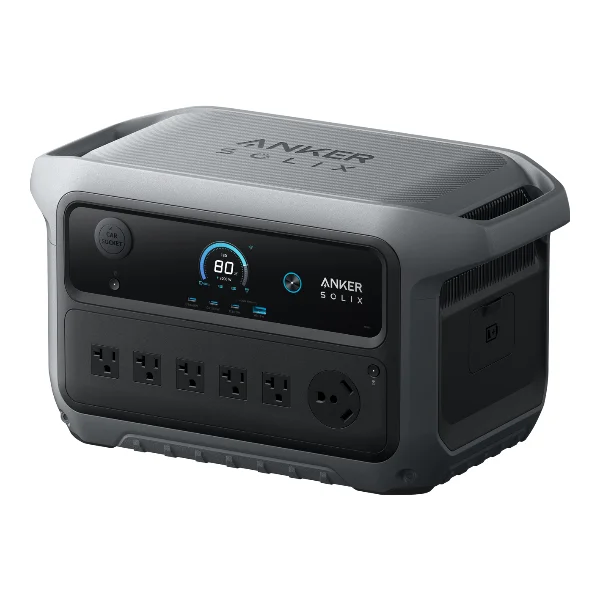 Best for townhouses and condosAnker SOLIX C2000 Gen 2 kit2,048 Wh at 41.7 lb. Carries up stairs; 4 kWh with one add-on battery.Check price on Amazon
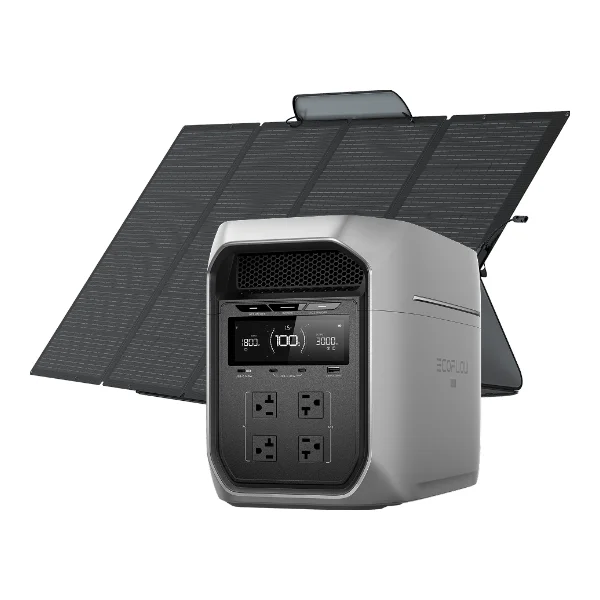 Best to start small and growEcoFlow DELTA 3 Max Plus kit2,048 Wh today, up to 10 kWh with two extra batteries. 3,000W output.Check price on Amazon
How much battery a home outage really takes
A home outage plan starts with one number: the watt-hours (Wh) your must-run devices use in a day. Most people need far less than “the whole house” and far more than they guess for winter.
Here is a typical essentials day. The wattages are average draws, not the label maximum, and you can swap in your own from the appliance sticker or a plug-in meter. Our outage planner does this math for you.
Battery runtime ≈ battery Wh × 0.85 ÷ load W. The 0.85 covers inverter losses.
Fridge and basics average about 98 W (2,340 Wh ÷ 24). A 3,584 Wh battery: 3,584 × 0.85 ÷ 98 ≈ 31 hours.
Add the furnace fan and the average jumps to about 225 W. The same battery lasts about 13.5 hours. Winter is what makes a home backup big.
| Device | Average draw | Hours per day | Wh per day |
|---|---|---|---|
| Refrigerator | 60 W | 24 | 1,440 |
| Wi-Fi router and modem | 20 W | 24 | 480 |
| LED lights, 4 bulbs | 40 W | 6 | 240 |
| Phones and a laptop | 30 W | 6 | 180 |
| Fridge and basics | 2,340 | ||
| Gas furnace blower (winter) | 382 W | 8 | 3,056 |
| Basics plus furnace fan | 5,396 | ||
| Sump pump in a storm | 160 W | 24 | 3,840 |
Furnace blower draw from a U.S. Department of Energy example for an older PSC motor; newer variable-speed blowers draw less. Sump pump: 800 W running about 20% of the time in heavy rain. Fridge: 60 W covers most full-size models; an ENERGY STAR 18 cu ft fridge averages closer to 41 W (DOE).
For context, the average U.S. customer sat through about 11 hours without power in 2024, and hurricanes Beryl, Helene and Milton caused most of it (EIA). In 2025 the average fell to about 4.5 hours, but averages hide the multi-day outages that send people shopping. Size for the outage you fear, not the average.
The six setups, up close
Each setup below gets the same treatment: what it does well, the catch, what it will not run, and the specs straight from the maker. Runtime figures use the essentials-day loads in the section above, so you can compare them one to one.
Jackery HomePower 3600 Plus with two SolarSaga 200W panels
Power station plus 2 × 200W folding panels (ships in separate boxes)
This is the setup we would hand a neighbor who says “I just want the fridge, the furnace fan and the Wi-Fi to make it through.” Its 3,584 Wh battery is the sweet spot for a winter essentials day: about 31 hours of fridge and basics, or about 13.5 hours with a gas furnace blower added, before the panels put anything back.
It is also the easiest big battery here to live with. At about 77 lb it rolls on wheels with a telescoping handle, so it can sit in the kitchen during an outage and in the garage the rest of the year. If one day of essentials turns out to be too little, Jackery sells add-on Battery Pack 3600 units, up to five, for about 21.5 kWh.
- Battery
- 3,584 Wh LiFePO4
- Output
- 3,600W (7,200W surge)
- Voltage
- 120V (240V needs 2 units)
- Expansion
- Up to about 21.5 kWh
- Solar input
- 1,000W max
- Weight
- About 77 lb, wheels
- Cycle life
- 6,000 to 70% (maker)
- Warranty
- 3 years + 2 with registration
- Enough battery for a full day of fridge and basics in winter
- Rolls like a suitcase; light for its capacity
- Four 20A outlets plus a TT-30 outlet
- Add batteries later instead of buying a second unit
- One unit is 120V only; 240V takes a second unit and a connector
- The two included panels use 400W of its 1,000W solar input
- Pass-through (UPS) mode tops out at 1,440W
- Jackery lists FCC compliance but publishes no UL listing
Best for: Most single-family homes on gas heat that need essentials through a one to two day outage.
What it won’t run: Central AC, an electric range or dryer, or a 240V well pump unless you pair two units.
Skip it if: your must-run list includes a 240V well pump and you want to buy only one unit.
Specs: Jackery HomePower 3600 Plus product page and user manual (3,584 Wh, 3,600W rated, 7,200W surge, 16 to 60V solar, 24A / 1,000W max, 6,000 cycles to 70%), checked Nov. 2, 2026.
EcoFlow DELTA Pro 3 with two 400W panels
Power station plus 2 × 400W folding panels (ships in separate boxes)
If your house runs on a well, this is the one to look at first. The DELTA Pro 3 puts out 120V or 120/240V split-phase from a single unit, with an L14-30 and a 6-20 outlet for 240V gear, so a well pump does not force you into buying two of anything.
It also ships with the most solar of any kit here: two 400W panels feeding a unit that accepts up to 2,600W. On a clear December day in Raleigh that pair puts back about 2,290 Wh by our math, close to a whole fridge-and-basics day. EcoFlow lists the unit as UL 9540 certified.
- Battery
- 4,096 Wh LFP
- Output
- 4,000W (8,000W surge)
- Voltage
- 120V or 120/240V, one unit
- Expansion
- 12 kWh per unit
- Solar input
- 2,600W max
- Weight
- 113.5 lb, wheels
- Cycle life
- 4,000 to 80% (maker)
- Warranty
- 5 years
- True 240V from one unit, including an L14-30 outlet
- Two 400W panels: the most included solar here
- 10 ms switchover for things that must not blink
- Maker lists UL 9540 certification
- At 113.5 lb it rolls on flat floors but not up stairs
- You pick the 120V group or the 240V group; both cannot run at once
- Each 400W panel is a two-person job on a windy day
- Largest box and biggest setup job in this guide
Best for: Homes on a well pump or with other 240V loads, and anyone planning to wire into Smart Home Panel 2.
What it won’t run: Central AC for more than a few hours, or an electric range and dryer at the same time.
Skip it if: you live upstairs or need to carry the unit; a lighter 120V setup covers you if you have no 240V loads.
Specs: EcoFlow DELTA Pro 3 product page and online manual (4,096 Wh, 4,000W, 8,000W surge, 120/240V, 2,600W solar, 4,000 cycles to 80%, 5-year warranty), checked Nov. 2, 2026.
Anker SOLIX F3800 Plus
Power station; panels sold separately (our math pairs it with 2 × Anker PS400)
The F3800 Plus is built to be the heart of a wired home backup, not a box you plug a lamp into. Its 6,000W of output is the most here, enough to start a well pump while the fridge and microwave are running, and it delivers 120/240V from one unit through an L14-30 outlet.
Its real edge is solar headroom. It accepts up to 3,200W of panels and expands to about 26.9 kWh with six BP3800 batteries, so you can start with a modest setup and grow it into something that rides out a long outage. Pair it with Anker’s Home Power Panel or a transfer switch installed by an electrician.
- Battery
- 3,840 Wh LFP
- Output
- 6,000W
- Voltage
- 120/240V, one unit
- Expansion
- Up to 26.9 kWh
- Solar input
- 3,200W max
- Weight
- About 136 lb, wheels
- Cycle life
- 3,000+ (maker)
- Warranty
- 5 years
- 6,000W: the most simultaneous power in this guide
- Biggest solar input here, 3,200W
- Expands further than any other single unit here
- Built around a home panel or transfer switch
- No panels in the box, so the real cost is higher
- About 136 lb; plan where it lives before it arrives
- Wall charging tops out at 1,800W, slow for a 3.8 kWh battery
- Pass-through backup covers only three outlets
Best for: Homeowners who will hire an electrician to connect selected circuits and want room to grow.
What it won’t run: A 5,000W dryer for long: it would empty the base battery in under an hour.
Skip it if: you want plug-and-play backup with no electrician; a lighter kit with panels in the box is simpler.
Specs: Anker SOLIX F3800 Plus product page and user guide (3,840 Wh, 6,000W, 120/240V, 3,200W solar, 6 × BP3800 to 26.9 kWh, 5-year warranty), checked Nov. 2, 2026. Anker lists the weight as 135.6 to 136.7 lb on different pages.
Jackery HomePower 3000 with two SolarSaga 200W panels
Power station plus 2 × 200W folding panels (ships in separate boxes)
The HomePower 3000 gives you a 3 kWh class battery and the same 3,600W output as the 3600 Plus in a smaller, lighter box. At 59.5 lb it holds the most watt-hours per pound of anything here, and a fridge alone would run about 43 hours on it by our math.
The trade is growth: it does not take add-on batteries. Buy it if you are confident that about a day of essentials is your target, and spend the difference on a plan for refilling it, like a dual-fuel generator outside or a second pair of panels.
- Battery
- 3,072 Wh LiFePO4
- Output
- 3,600W (7,200W surge)
- Voltage
- 120V
- Expansion
- None
- Solar input
- 1,000W max
- Weight
- 59.5 lb
- Cycle life
- 4,000 to 70% (maker)
- Warranty
- 3 years + 2 with registration
- Most battery per pound in this guide
- Same 3,600W output as the bigger Jackery
- TT-30 outlet for an RV or an inlet box
- Fast wall recharge, about 2.2 hours (maker)
- No expansion: what you buy is what you have
- 120V only
- Output is limited to 2,000W between 5°F and 14°F, so keep it out of a frozen garage
- Pass-through (UPS) mode tops out at 1,440W
Best for: Homes that want about a day of essentials in a battery one person can lift into a car.
What it won’t run: Any 240V load, or a furnace fan plus fridge for more than about half a day.
Skip it if: you think you may want more capacity later; the 3600 Plus or DELTA Pro 3 can grow.
Specs: Jackery HomePower 3000 product page and user manual (3,072 Wh, 3,600W, 7,200W surge, 1,000W solar, 4,000 cycles to 70%, not expandable), checked Nov. 2, 2026.
Anker SOLIX C2000 Gen 2 with PS400 bifacial panel
Power station plus 1 × 400W bifacial folding panel (ships in separate boxes)
Not every home backup needs to be a 100 lb appliance. In a townhouse or condo, where the fridge, Wi-Fi and a few lights are the whole list and the stairs are real, a 41.7 lb unit you can actually carry is worth more than extra capacity you cannot move.
The C2000 Gen 2 runs fridge and basics for about 18 hours by our math, recharges from the wall in about 88 minutes (maker), which matters during rolling outages, and switches over in 10 ms for a home office. One BP2000 battery doubles it to 4,096 Wh.
- Battery
- 2,048 Wh LFP
- Output
- 2,400W (4,000W peak)
- Voltage
- 120V
- Expansion
- Up to 4,096 Wh
- Solar input
- 800W max
- Weight
- 41.7 lb
- Cycle life
- 4,000 to 80% (maker)
- Warranty
- 5 years
- Light enough to carry upstairs
- Full wall recharge in about 88 minutes
- 10 ms switchover for a computer or modem
- Quiet: Anker lists 30 dB under 1,000W
- About 18 hours of fridge and basics, 7.7 with a furnace fan
- Tops out at 4 kWh even with expansion
- 800W solar cap limits a future array
- No home power panel option
Best for: Condos, townhouses and apartments with a short must-run list.
What it won’t run: A furnace blower plus fridge through a long winter night, or anything 240V.
Skip it if: you heat with a gas furnace in a cold climate and want a full day of heat and food covered.
Specs: Anker SOLIX C2000 Gen 2 product page and user guide (2,048 Wh, 2,400W, 4,000W peak, 800W solar, BP2000 to 4,096 Wh, 41.7 lb, 5-year warranty), checked Nov. 2, 2026.
EcoFlow DELTA 3 Max Plus with 400W panel
Power station plus 1 × 400W folding panel
The DELTA 3 Max Plus is the “buy what you need now” pick. It starts at 2,048 Wh, enough for about 18 hours of fridge and basics, but takes two extra batteries to reach 10 kWh, five times its base size. That suits a household that is still learning what it actually runs during an outage.
Its 3,000W output (3,800W in X-Boost mode) is stronger than most 2 kWh units, and it accepts up to 1,000W of solar, so the single included panel is a start, not a ceiling.
- Battery
- 2,048 Wh LFP
- Output
- 3,000W (6,000W surge)
- Voltage
- 120V
- Expansion
- 2 to 10 kWh
- Solar input
- 1,000W max
- Weight
- 48.7 lb
- Cycle life
- Not published
- Warranty
- 3 years + 2 with app registration
- Grows from 2 kWh to 10 kWh
- 3,000W output, high for its size
- Under 10 ms switchover
- 1,000W solar input leaves room for more panels
- No TT-30 outlet and no home panel listed, so wiring into circuits is harder
- Expansion needs EcoFlow’s adapter plus the batteries
- EcoFlow does not publish a cycle rating for this model
- One 400W panel puts back under half a winter essentials day in most of the country
Best for: Households that want a modest backup now and a path to a bigger one later.
What it won’t run: 240V loads, or circuits through a transfer switch without extra hardware.
Skip it if: you know you want hardwired circuits backed up; the F3800 Plus or DELTA Pro 3 are built for that.
Specs: EcoFlow DELTA 3 Max Plus product page and online manual (2,048 Wh, 3,000W, 6,000W surge, 2 to 10 kWh, 1,000W solar, 48.7 lb), checked Nov. 2, 2026.
Runtime and refill, side by side
This is the table we would want before buying: how long each setup carries the two essentials days above, and what its included panels put back on a clear December day in a mid-latitude city like Raleigh (3.81 peak sun hours, NREL).
| Setup | Battery | Fridge and basics | Plus furnace fan | Panels in the box | December refill, Raleigh |
|---|---|---|---|---|---|
| Jackery HomePower 3600 Plus kit | 3,584 Wh | 31 h | 13.5 h | 2 × 200W | about 1,140 Wh |
| EcoFlow DELTA Pro 3 kit | 4,096 Wh | 36 h | 15.5 h | 2 × 400W | about 2,290 Wh |
| Anker SOLIX F3800 Plus | 3,840 Wh | 33.5 h | 14.5 h | None (add your own) | about 2,290 Wh with 2 × PS400 |
| Jackery HomePower 3000 kit | 3,072 Wh | 27 h | 11.5 h | 2 × 200W | about 1,140 Wh |
| Anker SOLIX C2000 Gen 2 kit | 2,048 Wh | 18 h | 7.7 h | 1 × 400W | about 1,140 Wh |
| EcoFlow DELTA 3 Max Plus kit | 2,048 Wh | 18 h | 7.7 h | 1 × 400W | about 1,140 Wh |
Runtime = battery Wh × 0.85 ÷ average load (98 W and 225 W). Refill = panel watts × 0.75 real-world factor × 3.81 peak sun hours. Capacities from maker spec pages. Figures are estimates by our math, not measurements.
What the panels put back in winter, by city
Solar is the part of a “solar generator” that disappoints people most, and winter is why. Peak sun hours in December are often half of summer, and folding panels on the ground do worse than a roof array. Here is what two 200W panels, the most common kit, put back on an average December day.
| City | December peak sun hours | 2 × 200W panels | 800W of panels | Share of a fridge-and-basics day (2 × 200W) |
|---|---|---|---|---|
| Phoenix, AZ | 5.45 | 1,635 Wh | 3,270 Wh | 70% |
| Miami, FL | 4.70 | 1,410 Wh | 2,820 Wh | 60% |
| Raleigh, NC | 3.81 | 1,143 Wh | 2,286 Wh | 49% |
| Houston, TX | 3.75 | 1,125 Wh | 2,250 Wh | 48% |
| Boston, MA | 2.83 | 849 Wh | 1,698 Wh | 36% |
| Columbus, OH | 2.76 | 828 Wh | 1,656 Wh | 35% |
| Minneapolis, MN | 2.75 | 825 Wh | 1,650 Wh | 35% |
| Seattle, WA | 1.59 | 477 Wh | 954 Wh | 20% |
Peak sun hours: NREL PVWatts v8, fixed panel tilted at latitude, facing south, typical-year weather (TMY-2020). Output = rated watts × 0.75 × peak sun hours; the 0.75 is our allowance for heat, angle and wiring losses on portable panels. Cloudy storm days will be lower.
The takeaway is blunt. North of about Raleigh, a two-panel kit stretches a winter outage by hours, not days. If your outages come with ice storms, put your money into battery first and add panels later. If they come with hurricanes or summer wildfire shutoffs, panels pull far more of their weight, and an 800W array can carry a fridge-and-basics day on its own in the Sun Belt.
Which one should you buy?
| If your home… | Buy | Why |
|---|---|---|
| Needs the fridge, furnace fan, Wi-Fi and lights through a 1 to 2 day outage | Jackery HomePower 3600 Plus kit | Enough battery for a winter day of essentials, expands to 21 kWh, easy to move |
| Is on a well pump or has 240V loads you cannot skip | EcoFlow DELTA Pro 3 kit | 120/240V from a single unit and the largest included solar array here |
| Will be wired to a transfer switch to run several circuits at once | Anker SOLIX F3800 Plus | 6,000W output and the biggest solar input, built around a home panel |
| Wants a 3 kWh class battery for less | Jackery HomePower 3000 kit | 3,600W output and a TT-30 outlet in a smaller, lighter box |
| Is a townhouse or condo with modest loads and stairs | Anker SOLIX C2000 Gen 2 kit | 2 kWh you can carry, 4 kWh with one add-on battery |
| Wants to start at 2 kWh and grow | EcoFlow DELTA 3 Max Plus kit | Expands from 2 kWh to 10 kWh with extra batteries |
If you mostly need to keep one appliance alive, a whole-home kit is more than you need: a 1 to 2 kWh power station without panels does that job for a lot less money. Every kit we cover lives in our solar generator guides.
Who should skip a solar generator
Skip a solar generator if you need whole-house heating or cooling, if your winter outages run for days somewhere with little December sun, or if what you need to keep on is small enough for a far smaller battery. Here is how to tell, and what fits better.
| If this is you | Why a solar generator falls short | Look at this instead |
|---|---|---|
| You want central AC or electric heat running through a multi-day outage | Those loads draw far more than a fridge, for hours at a time. Even the 4,096 Wh DELTA Pro 3 would be empty in a fraction of a day. | A permanently installed standby generator, or a home battery system installed with rooftop solar and sized by an installer |
| Your winter outages last three days or more and you live somewhere like Seattle | Two 200W panels put back about 477 Wh on a December day there, about a fifth of the 2,340 Wh essentials day. | A dual fuel generator as a second layer, or more battery and more panels (see the winter table above) |
| You only need phones, a few lights and Wi-Fi through an evening | Wi-Fi for 11 hours (220 Wh), lights (240 Wh) and phones (180 Wh) add up to about 640 Wh. A 3 kWh kit is capacity you will not use. | A power station around 1,000 Wh, charged from the wall before the storm |
| You rely on powered medical equipment and cannot have any gap | One unit is a single point of failure, and a gray week may not refill it. | Enroll in your utility’s medical priority program, ask your equipment supplier about backup, and keep a second power source |
| You rent and have no sunny spot for panels | Panels in shade or behind window glass put back very little. | A battery-only power station you top up from the wall when a storm is in the forecast |
Runtime math: usable Wh = rated Wh × 0.85. Winter refill: rated panel watts × 0.75 × December peak sun hours (NREL PVWatts). Eleven hours is roughly the average U.S. customer’s total outage time in 2024 (EIA).
What to look for, in order of importance
1. Battery capacity (Wh) for your essentials day. Take your daily Wh from the table above and divide by 0.85. That is the smallest battery that carries you one full day without sun.
2. Continuous output and surge (W). Add the running watts of everything that might be on at once. A fridge can pull 1,200W for a second when its compressor starts, a well pump far more, so leave headroom.
3. 120V only, or 120/240V. Well pumps, many central AC units, electric dryers and some furnaces run on 240V. If you have one you cannot skip, it narrows your list to a few units.
4. Expansion. Can you add batteries later, and how far? It lets you start right-sized and grow without replacing the unit.
5. Solar input, not just panels in the box. The maximum solar watts the unit accepts decides how fast you can ever refill. A unit that accepts 2,000W or more lets you build a real array later.
6. LiFePO4 chemistry and a 5-year warranty. Every pick here uses LiFePO4 (LFP) cells, which last thousands of cycles and handle heat better than older lithium-ion.
7. A path to your home wiring. If you want to power hardwired loads like a furnace, check which transfer switch or home panel the maker sells and budget for a licensed electrician.
Safety and wiring: the short version
Battery units make no exhaust, so you can run them indoors, which is their biggest safety advantage over a gas generator. If you also own a gas or dual-fuel generator to recharge the battery, the U.S. Consumer Product Safety Commission is clear: never run it inside a home, garage, basement or shed, keep it at least 20 feet from the house with the exhaust pointed away, and install battery-backed CO alarms on every level. Nearly 100 people die each year in the U.S. from portable generator carbon monoxide.
To power hardwired circuits like a furnace or well pump, the unit has to connect through a transfer switch or a maker home panel installed by a qualified electrician. OSHA warns that connecting a generator straight into a building’s wiring can energize utility lines and endanger line workers. Never use a “suicide cord” from an outlet.
Ask about safety listings before you buy. UL 2743 is the standard for portable power packs and UL 9540 for installed energy storage systems; UL notes that combining separately certified parts in the field does not make a listed system. Of our six, only EcoFlow lists UL 9540 for the DELTA Pro 3; the others publish FCC compliance on their pages and manuals but no UL listing we could find, so ask the maker if your inspector or insurer requires one.
Is there a tax credit in 2026?
No federal credit, for most buyers. The IRS Residential Clean Energy Credit (Section 25D), which covered 30% of home battery storage of 3 kWh or more, does not apply to property placed in service after December 31, 2025, under the 2025 tax law. Some states and utilities still run battery or resilience programs, so check yours before you buy. Treat any listing that still promises “30% back from the IRS” with suspicion.
How we chose these six
We did not test these units ourselves. We compared maker spec pages and manuals for capacity, output, voltage, expansion, solar input, chemistry, warranty and safety listings, checked that each kit was in stock on Amazon for delivery to a U.S. ZIP code (10001) on November 2, 2026, and searched the CPSC recall database: none of these six models has been recalled. (EcoFlow recalled an older model, the DELTA Max 2000, in October 2025.) Then we ran every runtime and refill number in this guide with the same formulas and public data from NREL, EIA, DOE and CPSC, so you can check our math.
We left out units that were not yet buyable (BLUETTI’s Elite 200 V2 kit lists a November 18, 2026 release), installed wall batteries that Amazon does not sell, and permanent standby generators. Our How We Review page explains the method in full.
Back to that quiet house at 10 p.m. With the Jackery HomePower 3600 Plus kit, or whichever setup matches your numbers above, the fridge keeps humming, the furnace fan keeps the bedrooms livable, and the only math left for the night is how many hours until the crews show up.
Questions people ask before buying
What size solar generator do I need to run a house?
For essentials (fridge, Wi-Fi, lights, phones) plan on about 2,300 to 2,800 Wh per day; add a gas furnace blower in winter and it jumps to about 5,400 Wh. Running a whole house the normal way, with AC, an electric range and a dryer, takes 20 to 30 kWh a day and a system far beyond a portable unit.
Can a solar generator run a whole house?
Not the way the grid does. A 3 to 4 kWh unit runs selected circuits through a transfer switch for about a day. Expandable systems like the EcoFlow DELTA Pro 3 (12 kWh per unit, more in multi-unit systems) or the Anker SOLIX F3800 Plus (up to 26.9 kWh with six batteries) get closer, but central AC and electric heat still drain them fast.
How long will a 3000 watt solar generator run a refrigerator?
The watts tell you what it can start; the watt-hours tell you how long. A 3,072 Wh battery running a fridge that averages 60 W lasts about 43 hours (3,072 × 0.85 ÷ 60), before any solar refill.
Are solar backup generators worth it?
They are worth it if you lose power for a day or more at least once a year, need to run something indoors without fumes, or rely on a device like a CPAP or a sump pump. For short, rare outages, a smaller power station costs far less, and for week-long outages in winter a dual-fuel generator outdoors may be the lower-cost backstop.
What is the best brand for a solar generator?
Jackery, EcoFlow and Anker SOLIX lead for home backup because they publish full specs and manuals, use LiFePO4 cells, offer 5-year warranties and sell expansion batteries and home panels. The best brand for you is the one whose unit matches your Wh, watts and voltage.
Do solar generators work in winter or on cloudy days?
Yes, but slowly. In December, two 200W panels put back about 830 Wh a day in Columbus, Ohio, and about 1,640 Wh in Phoenix (NREL data, our math). Heavy cloud can cut that to a quarter or less.
Related guides
- Portable Power Stations for Home Backup, Ready Before the Storm Hits: five 1 to 2 kWh plug-in units, for when a fridge-first plan is enough and you want to skip the panels
Sources and Further Reading
- NREL PVWatts Calculator (solar resource data)
- EIA: U.S. electricity customers averaged 11 hours of outages in 2024
- EIA Electric Power Annual, Table 11.1: reliability metrics
- CPSC: carbon monoxide risks during power outages (Jan. 2026)
- IRS: Residential Clean Energy Credit
- FoodSafety.gov: food safety during a power outage
- UL Solutions: Q&A on portable power packs (UL 2743) and UL 9540